
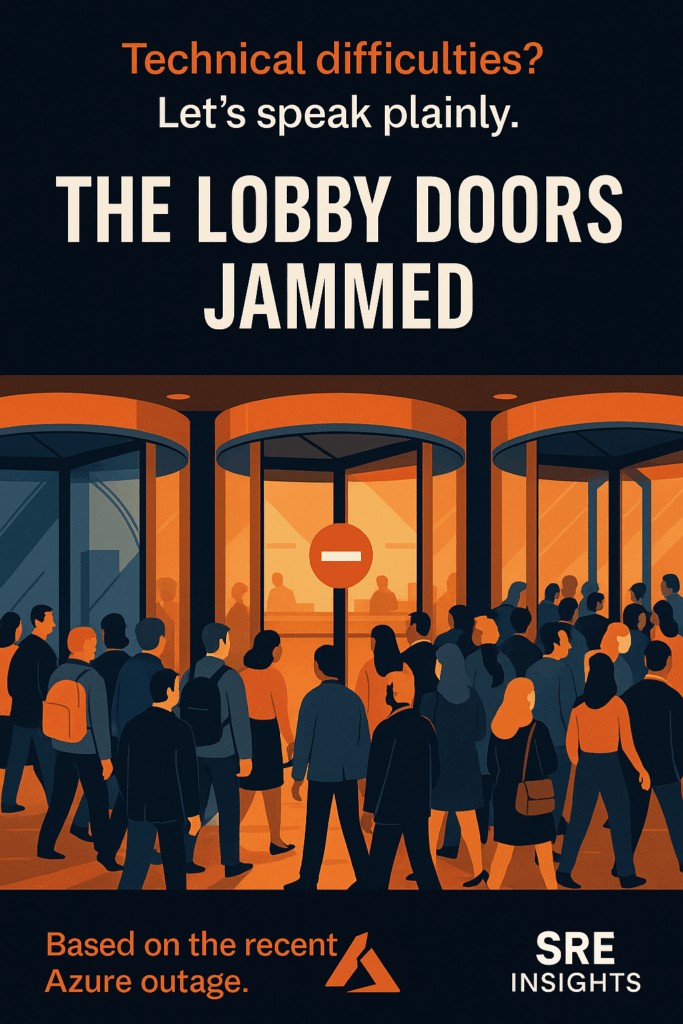
Inspired by the Oct 2026 Azure service disruption – Imagine you manage a large hotel.
Your main revolving doors — the high-traffic entryways that connect guests to everything inside — are like the Azure Front Door technology service in cloud terms. Through them, guests reach check-in desks, concierge, key access, dining reservations, spa bookings — every essential touchpoint.
What happened — “The front doors jammed”
On October 29, while maintenance work was underway, one of those main revolving doors was misconfigured.
Suddenly:
- Some doors started slowing down or sticking, leaving guests waiting outside.
- Others rerouted guests to side entrances not designed to handle that much traffic.
- As pressure built up, queues formed, and services inside the hotel — check-in, spa bookings, dining menus — became hard to reach, even though they were all running perfectly fine.
Why it spread — “All the entrances are linked”
In this hotel, all lobby doors share the guest load. When one door jams, guests naturally push toward the others.
At first, that seems fine — until the extra volume overwhelms those other doors too.
That’s exactly what happened here: a failure in one door caused traffic imbalance across the rest. The result was slower access everywhere, even though the hotel itself was fully staffed and operational. To guests, it felt like a complete shutdown — but in truth, it was a bottleneck at the entrance, not a failure inside.
How it was fixed — “Lock, reset, reopen”
To stop things from getting worse, management froze all door adjustments immediately — no more tinkering while assessing the damage.
They then rolled back to the last known good configuration, effectively resetting the door mechanisms to the way they worked before the issue.
Finally, they reopened the doors gradually, checking each one for smooth operation before letting full guest traffic back in. The process took hours but ensured the system came back cleanly and safely.
Why guests still felt the impact — “You could see the hotel, but couldn’t get in”
From the outside, the hotel’s lights were on. Guests could see the building, the signage, even parts of the lobby through the glass — but they couldn’t actually get inside.
That’s why:
- Loyalty logins (the identity service) didn’t work.
- Spa bookings and restaurant reservations (the business applications) failed or timed out.
- Some pages would load, but painfully slowly.
So while everything behind the scenes — staff, kitchen, rooms — was healthy, the front-door jam made it appear as if the entire operation was offline.
What we’re doing going forward — “Building backup doors and better monitoring”
This event reminded us of an old hospitality truth: when the lobby gets congested, the guest experience collapses fast.
Here’s what we’re taking away:
- Add a bypass entrance — a secondary access route for guests if the main doors fail (our technical equivalent: a backup front-door or alternate route to services).
- Tighten change control — no more maintenance on the main doors without staged testing and validation (or in tech: phased, ringed rollouts).
- Watch guest flow in real time — monitor for early signs of slowdown, not just outright failure.
- Design for continuity — ensure critical services like guest check-in (our login systems) can gracefully fall back if the front door jams.
How to communicate it — “A doorway failure, not a hotel shutdown”
Here’s how we’d explain it to our business and customers:
On October 29, we experienced a disruption at our “front door” — the system that connects guests to our services. The hotel itself remained operational, but access was intermittently impaired. We isolated the issue, reverted to a stable configuration, and restored normal operations.
While this was ultimately a doorway failure, we understand that this incident felt like a full hotel outage.
We’re now reinforcing our change safeguards and building alternate access paths to further reduce the chance — and impact — of similar incidents in the future.
Reference
The original post incident review(PIR) – https://azure.status.microsoft/en-us/status/history – see October 29th 2025 – Tracking ID for the post incident review(PIR) – YKYN-BWZ