
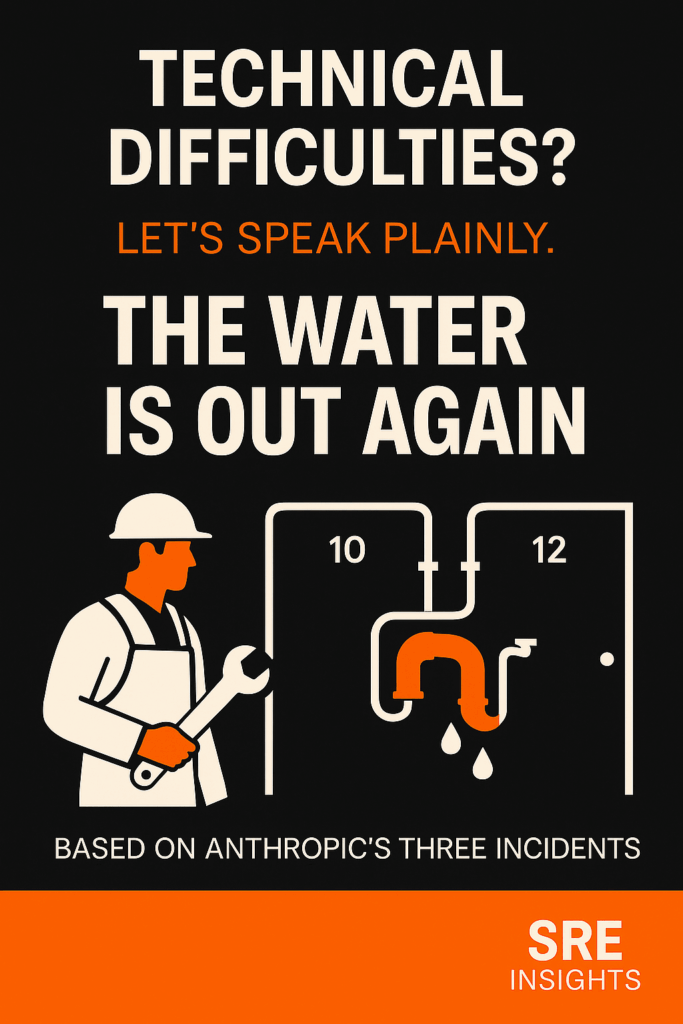
Inspired by 3 related and unrelated Anthropic incidents in 2026 – Imagine you manage a large apartment building.
Dozens of floors, hundreds of tenants, and a maze of shared infrastructure behind every wall.
Your goal: keep life smooth. Hot showers run, faucets flow, and everyone trusts the water will be there when they turn the tap.
But over a few weeks, three separate plumbing issues test that trust.
1. The Overzealous Maintenance Crew
You’ve automated parts of the building’s maintenance to make life easier.
One system regulates water pressure at night to balance demand. Another, newer automation checks pipe integrity and flushes the system to prevent mineral buildup.
One night, both routines happen to run at once.
Each system behaves correctly in isolation — but together, they interfere. Valves open and close in rapid succession, confusing the flow sensors.
For several floors, water pressure drops to zero.
By morning, the team identifies what happened. No pipes burst. No water lost. Just competing automation acting faster than the humans watching.
Lesson: Even helpful automation needs boundaries and coordination. When two well-meaning systems overlap, the interaction surface is the risk surface.
2. The Hidden Pipe Connection
A few weeks later, the plumbing crew begins upgrading fixtures on the 12th floor.
According to the building’s blueprints, the work should be safely isolated — “local change, no global impact.”
Halfway through, tenants on the 10th floor start calling: no water.
Turns out, decades ago, a contractor rerouted part of the system and tied both floors to a shared pipe hidden behind a false wall.
The team had all the right intentions and plans — but reality had drifted from documentation.
Lesson: Isolation isn’t a declaration; it’s a property that needs verification. Complex systems accumulate invisible coupling faster than we expect.
3. The Ignored Alarm
After those first two incidents, you decide to install leak detection alarms in the basement — a safety net for early warning.
At first, they’re great. But soon, minor false alarms start appearing: humidity changes, condensation, harmless fluctuations.
Over time, the maintenance team grows desensitized. They silence the alerts temporarily “just to get through the night.”
A week later, a real leak starts. The alarms stay quiet. The team discovers it through tenant reports rather than instrumentation.
Lesson: Warnings must earn and keep credibility. When signals lose meaning, silence stops being safety — it becomes blindness.
Seeing the Pattern
Each issue was different — one about automation overlap, one about hidden dependency, one about alert fatigue.
Individually, they were manageable. Collectively, they told a story:
Systems evolve faster than our assumptions about how they behave.
From the tenants’ perspective, it all looked the same: “The water’s out again.”
From the team’s perspective, it was a reminder that reliability isn’t just about fixing what breaks — it’s about deepening how we see what’s connected, what’s changing, and what we think we’ve already mastered.
Closing Reflection
Reliability isn’t perfection — it’s refinement.
In a living building, as in a live system, the work never stops: clarifying which valves control what, double-checking isolation before every change, and keeping alarms meaningful.
Because when the water keeps flowing, it’s not luck — it’s learning made visible.
References
- Anthropic Engineering Blog – A Postmortem of Three Recent Issues
- Rootly Blog – Lessons from Anthropic’s Retrospective